
What Are Polar Trends & How To Identify Them
A polar trend is a new (or existing) idea that is currently unheard of to the majority of people, but is likely to be very popular soon.

What is a polar trend?
A polar trend is the early stage of something that shows signs it’s going mainstream or widely adopted within a specific niche / industry soon.
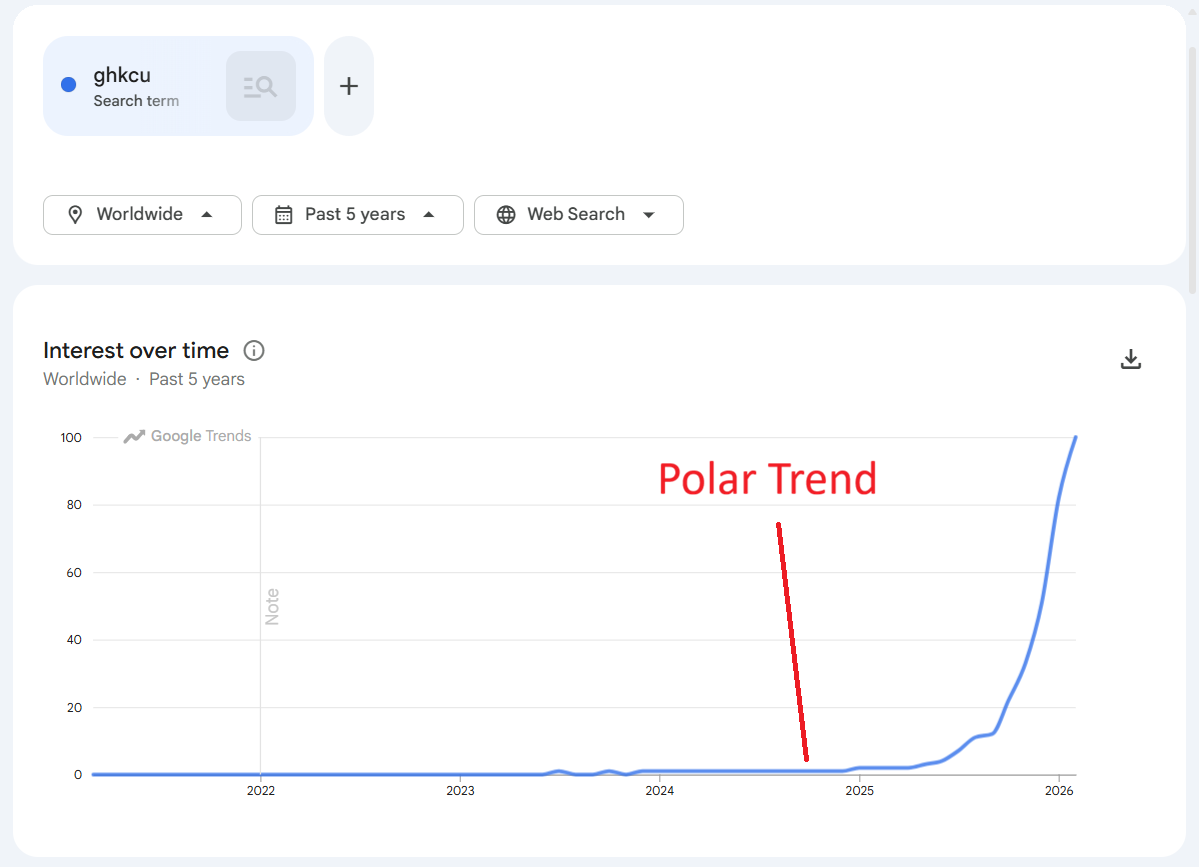
For instance, the below image shows the google trends data for a current viral topic which we chose at random. Here you can see when the topic became trending and when it was a polar trend.
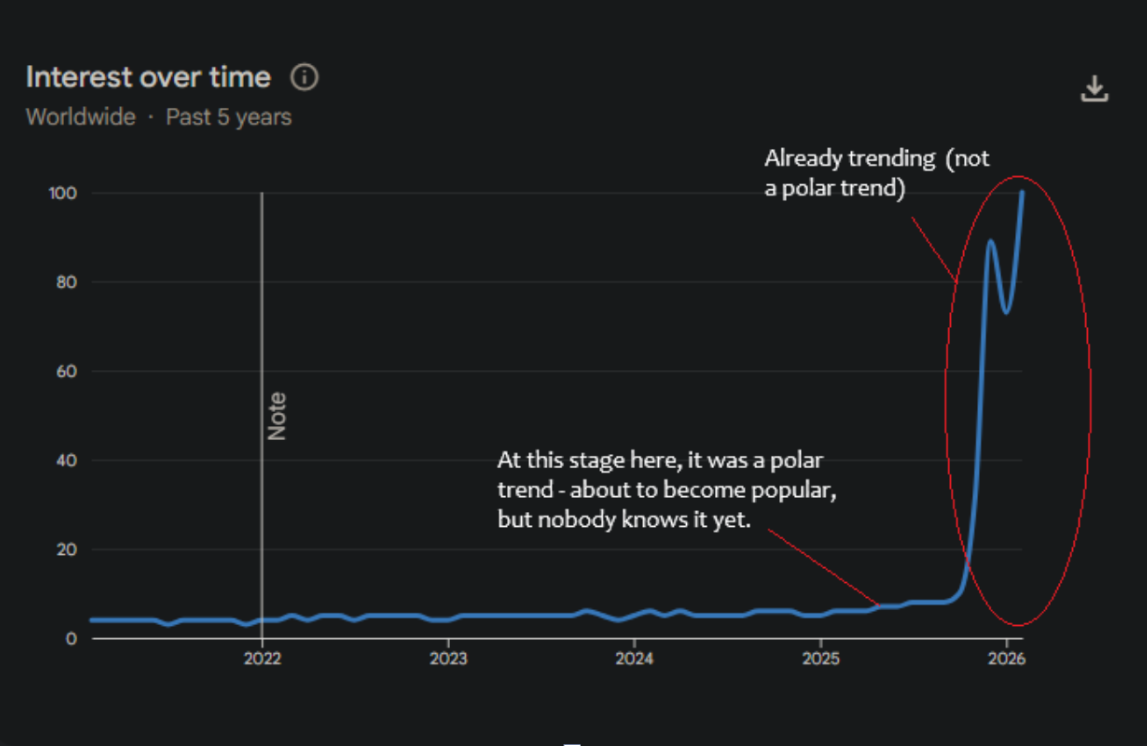
Another example……
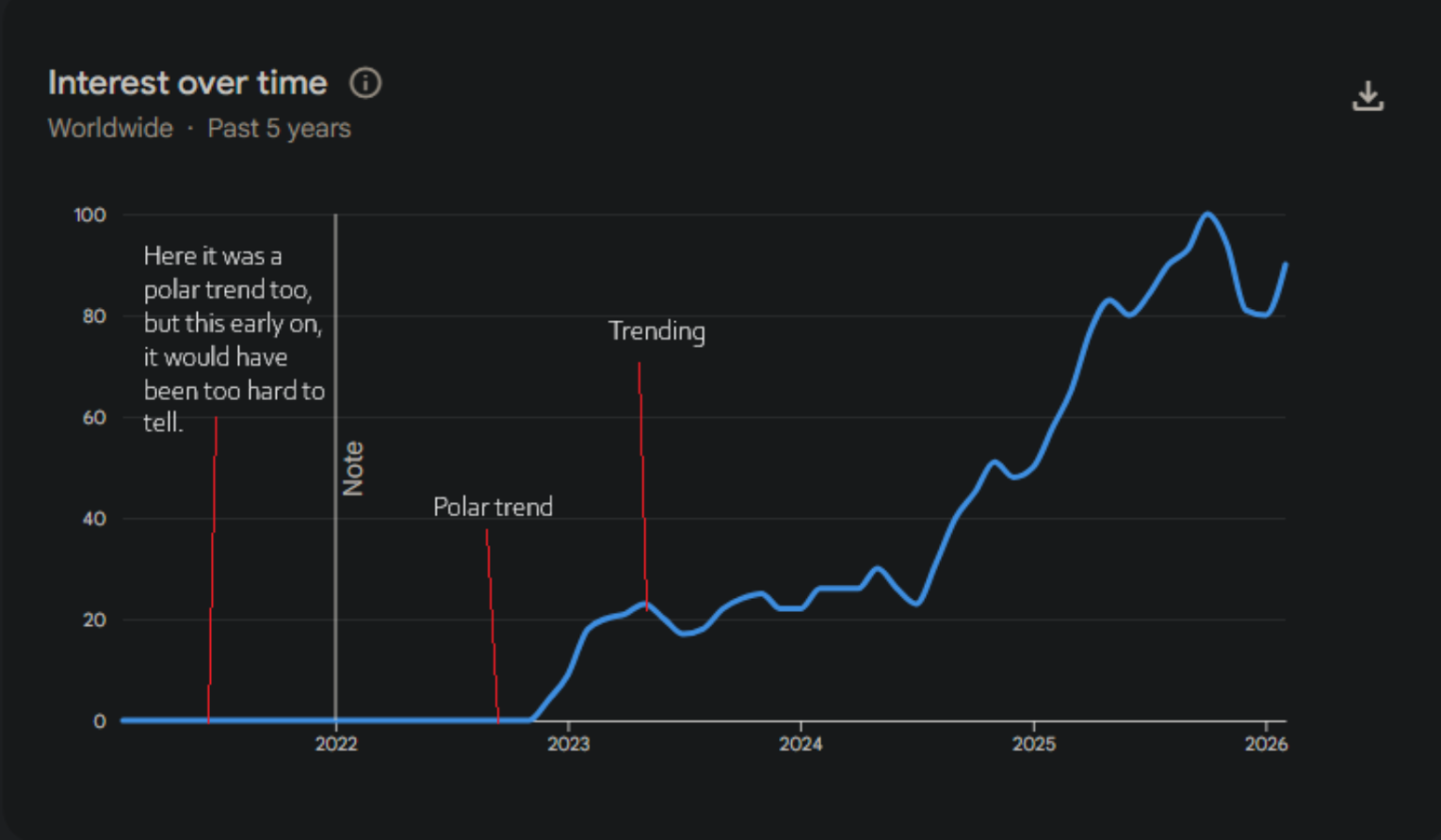
This is what a polar trend looks like when you’re REALLY early - little to no data whatsoever, but accelerating discussion online and in real life.
The term “polar trend” originated from underground marketing forums back in late 2022, after it was used to describe the phase before the sudden popularity of ChatGPT and other AI tech at the time.
The term is now used to describe emerging music, technologies, business models, social behaviors, aesthetics, fashion styles, internet culture, scientific methods, health practices, content formats, platforms, emerging subcultures and anything in-between.
……But unless you’re some kind of a fortune teller, how can you determine what will explode in popularity without relying on coincidence, pure luck or prediction?
Just because something new sounds cool or interesting, that alone does not mean people will adopt, use or talk about it in the future, if ever.
How To Tell If You Have Found A Polar Trend Early -
Recognise These 4 Signs
We looked at the early days of 200+ concepts or topics that later became popular. From that, we found 4 simple patterns that showed up in almost all of them.
Ranked from highest weighting to lowest, these are the four main factors that determine whether something is a polar trend:
- Lack of information online, but evidence of fast adoption - Occurring in 200 out of 200 topics we looked at
- Gap filling, problem solving or pain killing - Occurring in 112 out of 200 topics we looked at
- Expanding out of niche - Occurring in just 98 out of 200 topics we looked at
- CDOC - Not easy to to check, but still important. Ties into point 1 ↑
1 - Lack of clear information online, but evidence of fast adoption
When people are talking about something, but there is a lack of info when you try to search for it online, this factor alone strongly indicates that the adoption of the topic / idea is accelerating so quickly that the content creators, journalists, businesses and media can’t keep up.
At this stage, the idea is spreading person-to-person, not business-to-person. People are using it, referencing it, or experimenting with it faster than journalists, businesses who do SEO, and content creators can document it.
Here is a totally hypothetical situation for the sake of example:
assume it’s the early 2010s and a coworker says something about ‘low-code development.’
Then you go onto reddit, and you come across a post mentioning low code development.
Then by night, your friend is talking about how he plans to make a simple site for his landscaping business using a low-code development platform.
Now If you were to try to look up “low-code development” on Google, YouTube or anywhere on the internet, there may be hardly any content available, or the information you do find doesn’t clearly satisfy your search intent. The search results may be very messy and confusing.
In this example, It’s clear that people are interested in low-code development, yet it’s so new that there is little to no information, functional resources and about it online.
2 - Gap filling, problem solving or pain killing
If a new concept either:
- fills a gap
- solves a problem more efficiently or effectively than existing solutions, or
- eliminates a clear pain point,
then any one of these alone is a strong indicator that it will soon become a topic of interest.
Even if people were not aware that they had the problem before, a new concept may enter the market and spread naturally simply due to being better than what already exists.
So let’s say you come across a song on Spotify with only 200 streams and the artist only has a couple thousand monthly listeners.
It’s the best song you’ve ever heard in your life…..so how does it only have 200 streams? There’s no doubt that other people are going to love it as well.
Even at just 200 streams, you know that when other people find this song, they’ll definitely share it, use it in their instagram stories etc... .without needing to be paid by the artist, just because of how much they like the song.
Another great example of this is red light therapy. The concept sounded silly at first, but after initial users realised how good it was, it spread like wildfire.
Nobody asked for a mask that shines red light on their face.
But when people first started using RLT and saw visible results, of-course, they would share it organically because it solved a major pain point that existing solutions could not target and solve as effectively.
3 - Breaking out of its original niche
If you can notice the topic getting used / adopted by those who are not usually interested in the topic, that could also reinforce point 2 above (gap filling, problem solving or pain killing).
People love the concept so much that even those who aren’t involved in the specific industry also use it.
For example, Hardstyle music used to be very niche - only some people listened to it. Now it’s almost a mainstream genre of music in some parts of the world.
The same goes for the LCD example mentioned above - Low code development is specifically targeted to those who are not technical, even though it’s literally made to do something that software developers usually do.
4 - CDOC
Cross-dataset outlier convergence (commonly abbreviated as CDOC) is by far the strongest indicator that something is a polar trend.
It's positioned as 4 on this list, only because it is near-impossible to find CDOCs in various datasets. Doing so would require access to data that is either private or simply not collected at all.
If there were a reliable way to accurately identify CDOC patterns early, it would likely be the #1 factor for determining a polar trend. In fact, CDOCs can almost be assumed to occur in nearly 100% of polar trends.
CDOC happens when an outlier in one dataset shares a similarity with outliers in other datasets. Although the abbreviation itself does not specify it, CDOC usually refers to positive outliers - cases where the value is unusually high in a favorable way.
For example -
- Pink ice cream sells more than other ice creams at ice cream shop A, Ice cream shop b and also Ice cream shop B
- Pink ice cream sales increased more than two standard deviations above the mean at supermarkets
- A video about pink ice cream outperforms the creator's other videos
- City council suddenly has an increase of pink ice cream wrappers in the garbage bins
- Delivery drivers notice a higher number of orders that include pink ice cream from different dessert stores.
Much of this data is either private or not formally collected, which makes it hard to identify trends early. As a result, it can be difficult to realize that something like pink ice cream is trending until it becomes clearly popular online, through viral social media videos, increased Google search volume, or more mentions on trend analytics tools like Semrush or Exploding Topics etc....
CDOC demonstrates genuine, real-world consumer engagement with the subject. This connects to points 1 and 2 mentioned earlier:
1 - Lack of clear information online, but evidence of fast adoption
2 - Gap filling, problem solving or pain killing
Other Possible Signs That Something May Be A Polar Trend
Listed below are 3 more reasons why something could be trending soon, but these factors are far less direct and should be treated as supporting signals rather than strong indicators.
- Infrastructure around the topic
When tools, platforms, or services start forming around a topic, it shows that some demand exists. However, this usually means the idea is already too popular, not early. In many cases, the infrastructure grows after interest has peaked, not before.
- History and reputation of creator
If the creator behind a topic has a strong history of building or launching successful things, it increases the chances that their new idea will gain attention. However, past success doesn’t guarantee future success. Even well-known creators can release ideas that flop, while many massive trends come from complete unknowns with no reputation at all.
Example -
• A famous artist releases a song that never goes mainstream
• A first-time founder creates a bakery that makes cakes so delicious and the company goes viral!
- Organic, unpaid growth
Common, but not guaranteed.
Organic, unpaid growth shows genuine interest, people are sharing and talking about it without being pushed. That usually means real value.
….But this is not necessarily true. It’s just a strong supporting indicator,
If you look into it, a lot of new inventions are where they are today thanks to paid advertising. Smartphones for example, grew massively via paid ads on TV and on social media.